Unit 22: Digital Etiquette
Warm-up and Vocabulary
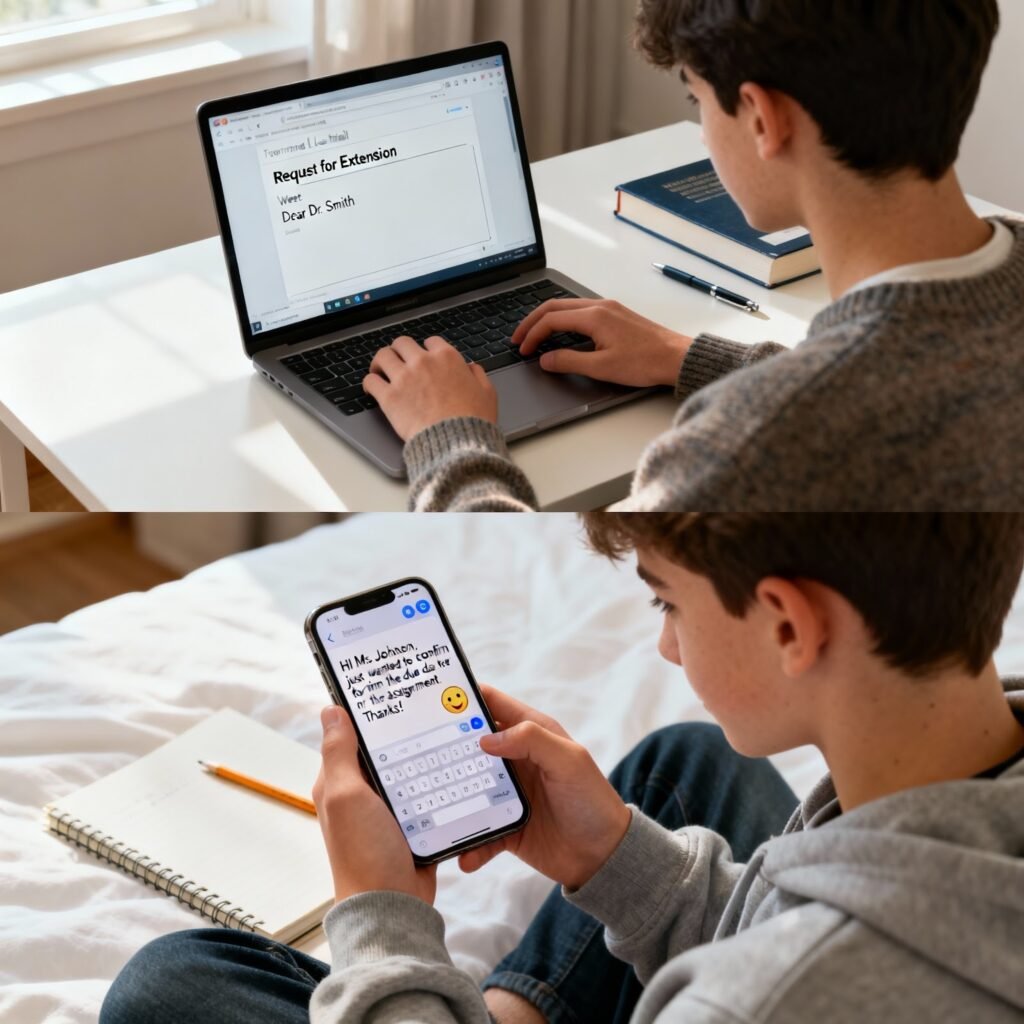
How do you send a message to your teacher? How do you send a formal email? We must be polite. This is called Digital Etiquette. Today, we learn words to make your writing clear and polite. Let’s learn the words!
| Word | Definition (in simple English) |
| Netiquette | The rules of polite behavior online. |
| Tone | The “feel” of your message, for example friendly, neutral, or harsh. |
| Context | The situation and purpose that shape how you should communicate. |
| Privacy | Protecting personal information and not sharing others’ data without permission. |
| Consent | Getting permission before tagging, adding to groups, or sharing photos and content. |
| Boundaries | A person who writes mean comments online to make others angry. |
| Professionalism | Communicating in a respectful, work appropriate way online. |
| Spam | Unwanted or repeated messages that bother people. |
| Misinformation | False or inaccurate information shared online. |
| Cyberbullying | The “feel” of your message, for example, friendly, neutral, or harsh. |
Activity 1: Crosswords
Activity 2: Check Your Vocabulary
Choose the best answer.
Putting Your Ideas in Order
In academic writing, a paragraph is more than just a list of sentences; it is a structured argument. For your writing to be effective, it must be:
- Logical: Your ideas must be in a sensible, step-by-step order.
- Coherent: All of your sentences must “stick together,” focusing on a single main idea.
- Cohesive: Your ideas must flow smoothly from one sentence to the next.
The “glue” that connects these sentences and ideas is Transition Words. They act as signposts, guiding the reader through your logic and making your argument easy to follow.
Tier 1: Sequential Transitions (For Basic Order)
The most fundamental transitions are those that establish a clear order. They are essential for instructions, narratives, or basic emails.
- First,
- Second,
- Then,
- Next,
- Finally,
Example Analysis: Let’s analyze two emails. One is “incoherent” (it’s just a disconnected list), and one is “cohesive.”
- ❌ Incoherent Email (Lacks Cohesion):
Subject: homework i am sick. i need the homework. thank you.
This message is confusing and impolite. The ideas are disconnected. - ✅ Cohesive Email (Uses Transitions):
Subject: Homework – Budi – Class XA
Dear Ms. Rina,
First, I am writing to inform you that I am sick today and cannot come to class. Also, I would like to respectfully request the homework for today.
Thank you, Budi
This email is polite, logical, and easy to read because the transitions create a clear flow.
Tier 2: Formal & Additive Transitions (For Academic Writing)
When you write a formal essay or a professional email, you should use more formal transitions to connect your ideas.
- To Add Another Idea (Instead of Also):
- Furthermore,
- Moreover,
- In addition,
- To Show a Result (Instead of So):
- Therefore,
- As a result,
- To Conclude (Instead of Finally in a list):
- In conclusion,
- To summarize,
Example (Formal):
“Driving cars is a major cause of pollution. Furthermore, it leads to traffic congestion. Therefore, cities should invest in better public transport.”
Skill Practice
(15 minutes)
Activity 1: Choose the Best Word (Multiple Choice)
Read the email. Choose the best transition word for each blank.
Activity 2: Put the Message in Order
Put the sentences in the correct order to make a polite message.