Unit 2 – Describing my Family
Warm-up and Vocabulary
First, let’s learn the key words for describing family.
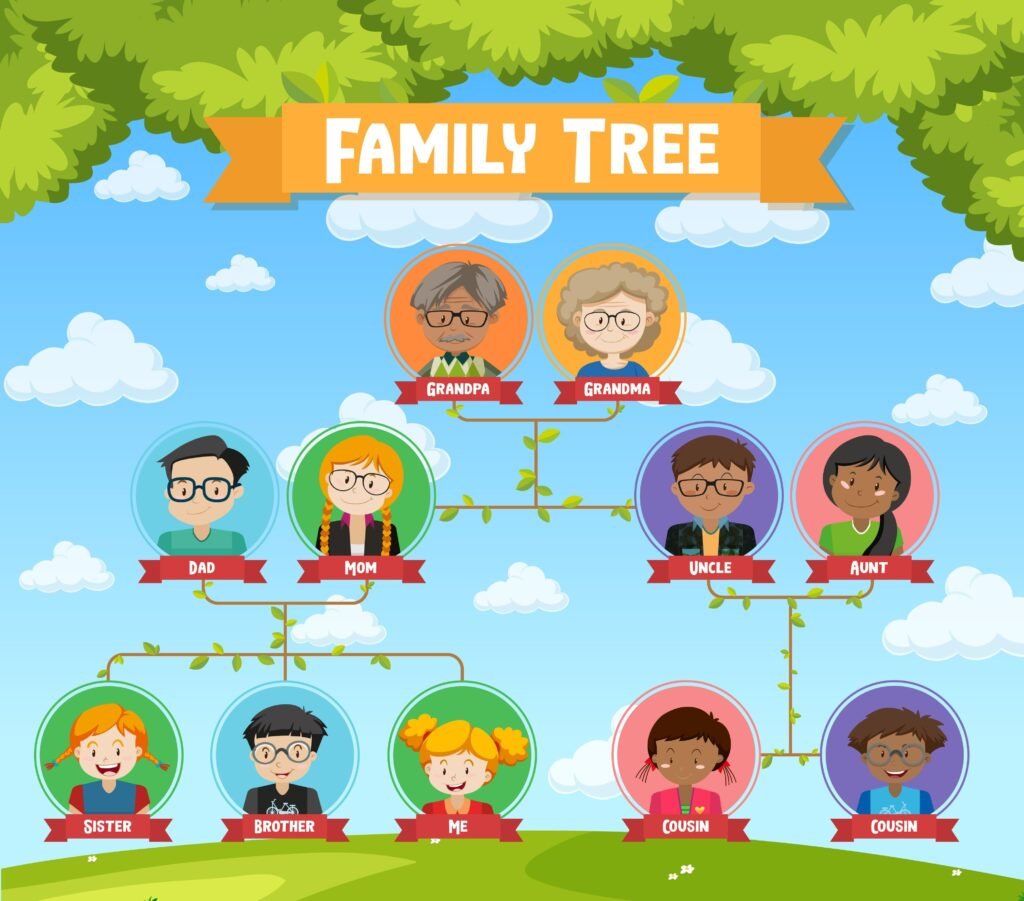
Family Members (The Who)
- Father: Your male parent. My father is a doctor. He is very kind.
- Mother: Your female parent. My mother has long hair. She works at a bank.
- Brother: A boy who has the same parents as you. I have one brother. He is good at mathematics.
- Sister: A girl who has the same parents as you. My sister is very tall. She likes to play tennis.
- Parents: Your father and mother. My parents are from Canada. They have a big house.
Action & Description Words (The What)
- is / are: (to be) He is tall. They are kind.
- has / have: (to own) She has black hair. They have a car.
- works: (to do a job) My father works in an office.
- studies: (to learn at school) My sister studies English
- kind: (adjective) Nice, friendly.
- tall: (adjective) Having a greater than average height.
Matching Activity
Sentence Blocks: Building a Description
A good sentence is like building with blocks. For a simple description, you need three blocks:
Block 1: Subject (Who) + Block 2: Verb (Action/Is) + Block 3: Detail (What/Where)
Let’s see how they connect.
| SUBJECT | VERB | DETAIL | FULL SENTENCE |
| My father | is | a doctor. | My father is a doctor. |
| My mother | has | long hair. | My mother has long hair. |
| My brother | studies | at school. | My brother studies at school. |
| My parents | are | very kind. | My parents are very kind. |
Important Tip:
- Use is, has, works, for one person (he, she, my father)
- Use are, have for more than one person (they, my parents)
Tips for Success
- Start Simple: Use the basic sentence patterns you’ve learned. For example: “My father is a doctor.” or “I have one sister.”
- Make a Quick Plan: Before you write, draw a simple mind map. Write a family member’s name (e.g., “Mother”) and then write keywords around it (e.g., works, kind, long hair).
- Use Your Vocabulary: Try to use all the new words you learned about family members and descriptions.
- Check Your Work: After writing, read your sentences again. Check for capital letters at the beginning and periods (.) at the end.
Skill Practice
Now, let’s practice building your own sentence blocks!
Activity 1: Build a Sentence
Activity 2: Choose the Correct Block
You’ve reached the end of the lesson. Click the button below to begin your Evaluation Quiz