Unit 26: Music in My Life
Warm-up and Vocabulary
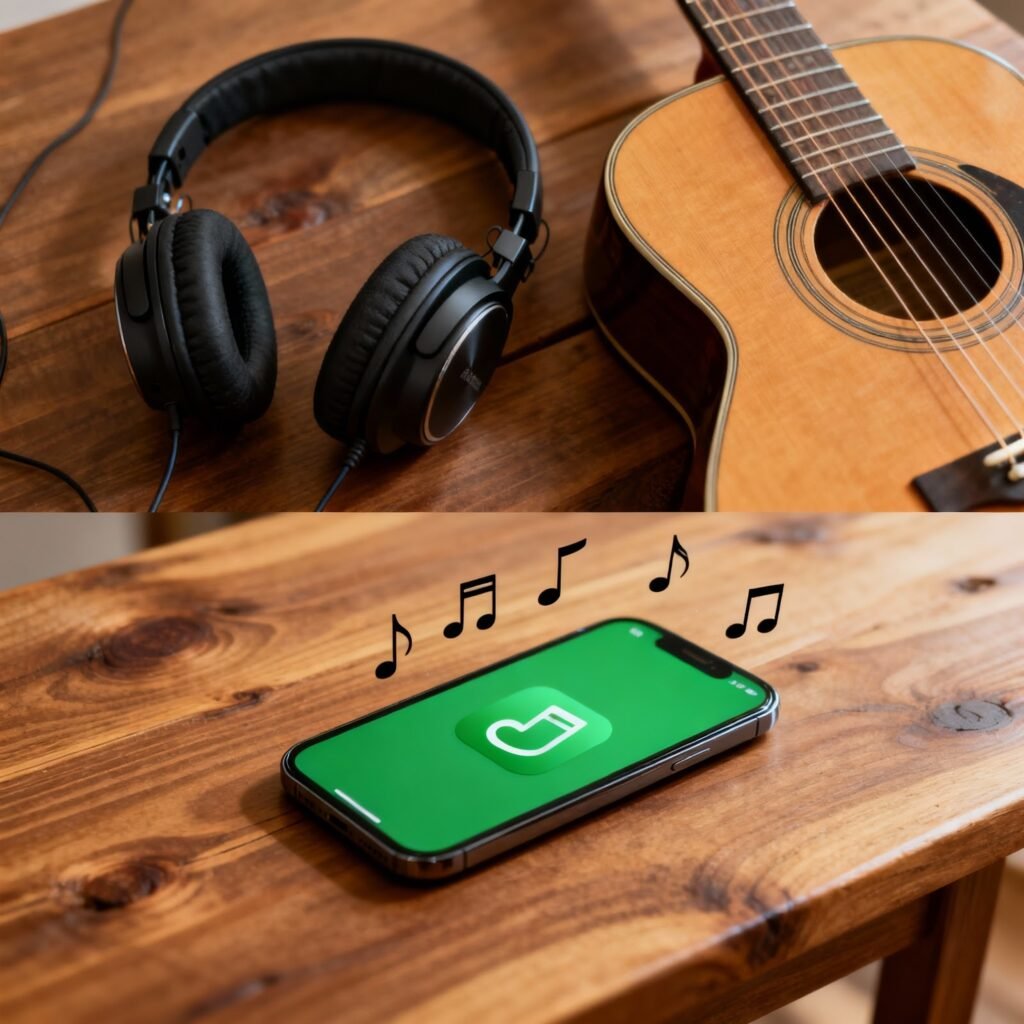
Do you listen to music every day? What is your favorite song? Today, we will learn how to write about the music you liked in the past and the music you like in the present. Let’s learn the words!
| Word | Definition (in simple English) |
| music | Sounds (like songs) that people listen to. |
| listen | To use your ears to hear a sound. |
| song | A short piece of music, usually with words. |
| pop | A type of popular music (e.g., K-Pop). |
| rock | A type of music, often loud with guitars. |
| rap | A type of music with fast, rhyming words. |
| past | The time before now (e.g., yesterday). |
| present | The time that is happening now (e.g., today). |
Activity 1: Vocabulary Match
Activity 2: Check Your Vocabulary
Choose the best word to complete the sentence.
Writing About Time: Past and Present Tense
When we write, we are all time travelers. We can talk about last year, what’s true every day, or what’s happening right this second.
How do we do this? We don’t need a machine; we just change the verb. This is called tense. But it’s not just when (tense), it’s also how the action happens (aspect). Is it a simple fact? Or is it an action in progress, like a live stream?
Let’s look at a few ways we shape time in our writing.
The Present Lenses (What’s Now)
This isn’t just one “present.” It’s about how you see the “now.” Is it a permanent fact, or is it a live stream?
- The Simple Present (The “Fact” Lens) This is your lens for truths. Use it for things that are always true, or for habits that happen over and over. It’s simple, permanent, and factual.
- Example: “I listen to music every day.” (This is your habit.)
- Example: “The sun rises in the east.” (This is a fact.)
- The Present Continuous (The “Live Stream” Lens) This lens shows an action in progress. It’s not just a fact; it’s a “live stream” of what is happening right this second. It’s temporary and active.
- How to use: am/is/are + verb-ing
- Example: “Be quiet! I am listening to a new song.” (The action is happening now.)
- The Present Perfect (The “Bridge” Lens) This is a special lens. It builds a bridge from the past to the present. The action happened in the past, but it has a result or an importance now.
- How to use: have/has + past participle
- Example: “I have heard that song before.” (The experience of hearing it is with you now.)
The Past Lenses (What’s Done)
When you look back, you’re not just looking at one “past.” You’re telling a story. You need a lens for the main action and one for the background.
- The Simple Past (The “Finished Photo” Lens) This is a snapshot of a completed, finished action. The event is over, and you’re just reporting it.
- How to use: verb-ed
- Example: “I listened to that album yesterday.” (The action is 100% done.)
- The Past Continuous (The “Scene” Lens) This is the “background” lens. It sets the scene. It describes what was happening when the main action (the “finished photo”) suddenly interrupted it.
- How to use: was/were + verb-ing
- Example: “I was listening to music (the scene) when my friend called (the interruption).”
- The Past Perfect (The “Time Machine” Lens) This is your “time machine.” You use it when you are already in the past, but you need to jump to an even earlier past.
- How to use: had + past participle
- Example: “When my friend called, I had already finished my homework.” (The homework was finished before the friend called.)
The Future Lenses (What’s Next)
Looking forward, you can either be making a guess or stating a plan. The lens you choose shows how certain you are.
- The “Crystal Ball” (will) This lens is for predictions, guesses, or sudden decisions made in the moment. It’s not a firm plan.
- How to use: will + verb
- Example: “I love this song! I will add it to my playlist.” (A sudden decision)
- The “Blueprint” (be going to) This lens is for a solid plan. You’ve already thought about it; you have the “blueprint.” It’s an intention for the future.
- How to use: am/is/are + going to + verb
- Example: “I am going to the concert on Friday.” (This is a plan; I probably have tickets.)
Skill Practice
Activity 1: Choose the Correct Verb
Choose the best verb to complete the sentence. Look for the time words!
Activity 2: Put the Words in Order
Choose the correct sentence.
Activity 3: Crossword