Unit 25: Freedom of Speech vs. Hate Speech
Warm-up and Vocabulary
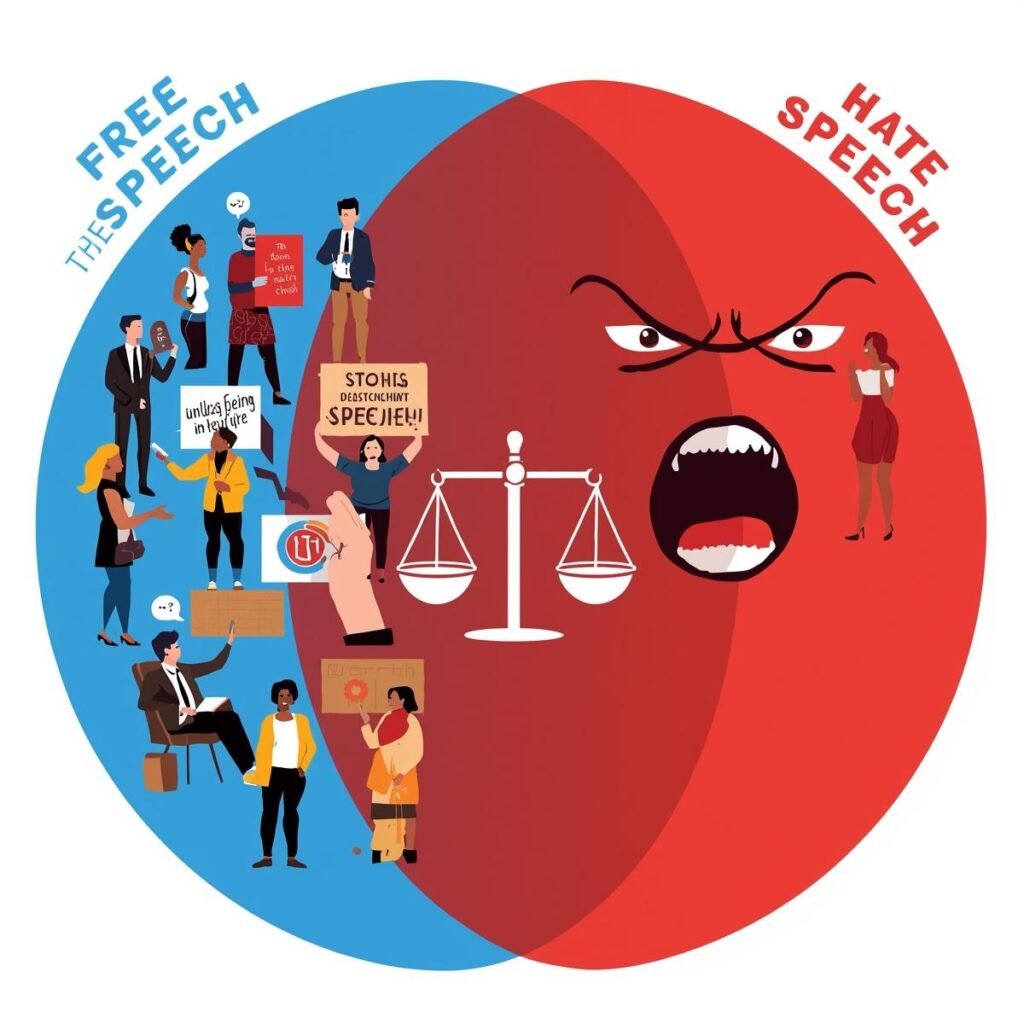
Hello, Future Leaders! Welcome to Unit 25. We all love to share our opinions on Instagram or Twitter, right? But is there a limit? Can you say anything you want, or are some words too dangerous? Today, we are tackling a tough topic: Freedom of Speech versus Hate Speech. In this Listening unit, we will learn how to hear the difference. You will practice spotting ‘Comparison Clues’—words that tell us when things are the same or different. Let’s find the balance!
Vocabulary List
Read the list below carefully. You will need these words to understand the listening passages.
- Freedom of Speech: The right to express any opinion without censorship.
- Hate Speech: Words that attack or insult a group of people (based on race, religion, etc.).
- Compare: To look for similarities (how things are the same).
- Contrast: To look for differences (how things are different).
- Offend: To make someone feel upset, angry, or insulted.
- Limit: The point where something must stop; a boundary.
- Right: Something you are allowed to do by law.
- Harm: To hurt or damage someone.
- Threaten: To say you will hurt someone.
- Debate: A formal discussion on a particular topic where opposing arguments are put forward.
Activity 1: Let’s Discuss
Look at the questions below. Think about your answers or discuss them with a partner.
- Have you ever seen a comment on social media that made you very angry? What was it about?
- If someone says, “I hate your hairstyle,” is that Free Speech or bullying? Why?
- Should the government arrest people for writing mean things online? Where is the limit?
Spotting the Difference: The “Compare & Contrast” Signals
In academic listening, speakers often compare two things to explain them better. They use Signal Words to tell you if they are talking about Similarities (Same) or Differences (Opposite).
1. Signal Words for SIMILARITY (The Same)
When you hear these, the speaker is saying the two things are alike.
- Like / Alike: “Like freedom, responsibility is important.”
- Similarly: “Use Twitter. Similarly, use Instagram.”
- Both: “Both freedom and hate speech involve words.”
- Also / Too: “This is also true for…”
2. Signal Words for DIFFERENCE (The Opposite)
When you hear these, the speaker is switching sides.
- However: “You can share opinions. However, you cannot threaten people.”
- Unlike: “Unlike free speech, hate speech causes violence.”
- On the other hand: “I like blue. On the other hand, he likes red.”
- While / Whereas: “Free speech is legal, while hate speech is often illegal.”
- But: “You can say that, but don’t be rude.”
3. Context Example (The Line):
- Speaker: “Giving a bad review of a restaurant is Free Speech. It is an opinion. However, lying and saying the owner is a criminal is Defamation (not allowed).”
- Comparison: Bad Review vs. Lying.
- Signal: “However”.
Skill Practice
Complete the following 4 exercises.
Exercise 1: Word Search
Find the 10 vocabulary words in the grid below. Words are Horizontal (Left to Right) or Vertical (Top to Bottom).
Exercise 2: Sorting Signals
Exercise 3: Listening for Comparison
Listen to the short sentences. Determine if the speaker is saying the two things are Similar or Different.
Exercise 4: Fill in the Blanks