Unit 19 – Surveillance vs. Privacy
Warm-up and Vocabulary
Hello! Have you ever felt like someone is watching you? Today, we are discussing a very hot topic: Surveillance versus Privacy. We will read about how cameras and apps track us, and we will practice understanding difficult sentences. By the end of this lesson, you will be a master at finding hidden meanings in texts. Let’s dive in!
Vocabulary List
Read the list below carefully. You will need these words to understand the reading passages.
- Surveillance: Closely watching someone or a place (usually by cameras or police).
- Privacy: The right to keep your personal life secret.
- Track: To follow the movement or path of someone.
- Data: Information (numbers, facts, photos) stored by computers.
- Monitor: To watch and check a situation over time.
- Consent: Giving permission; saying “yes”.
- Anonymous: Without a name; nobody knows who you are.
- Footage: The video recorded by a camera.
- Breach: Breaking a law or rule (e.g., a data breach means hackers stole info).
- Identify: To recognize and name someone.
Activity 1: Let’s Discuss
Instruction: Look at the questions below. Think about your answers or discuss them with a partner.
- Do you cover your laptop camera with a sticker? Why or why not?
- There are CCTV cameras in many schools and malls. Do they make you feel safe, or do they make you feel watched?
- If a free app asks for your location (GPS), do you say “Yes” or “No”? Why?
Activity 1: Check Your Vocabulary
The “Backward Arrow” Strategy
Who is Who? (Connecting Pronouns)
Read the explanation below. In TOEFL Reading, you must know exactly who or what a word refers to.
1. The Basic Rule Pronouns (he, she, it, they) usually refer to a noun mentioned before them.
- Example: “The camera is broken. It needs repair.”
- (“It” = The camera).
2. Complex References (The Target) In intermediate reading, words like “Which”, “That”, or “This” often refer to a whole idea or a sentence, not just one word.
How to solve it? Use the Backward Arrow. When you see a reference word, draw an arrow backward to find the action or situation.
- Type A: “Which” (Connects two parts of a sentence)
- Example: “The school installed cameras in the toilets, which made the students angry.”
- Question: What does “which” refer to?
- Answer: Not “toilets”. It refers to “the installation of cameras in the toilets”. (The whole action made them angry).
- Type B: “This” (Refers to the previous sentence)
- Example: “Hackers can steal your passwords easily. This is why you need strong security.”
- Question: What does “This” refer to?
- Answer: “Hackers stealing passwords easily.”
3. The “People” References (Who / Whom / Whose)
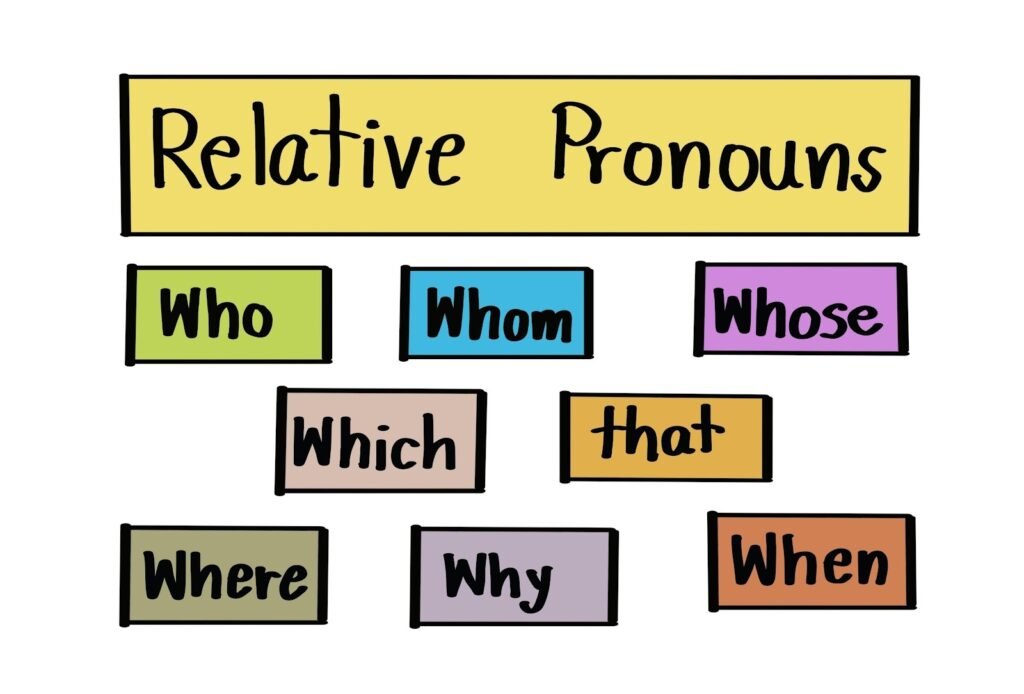
These three words always refer to PEOPLE, but they have different jobs:
- WHO (The Subject / Actor)
- Refers to the person doing the action.
- Look for: Person + Verb
- Example: “The hacker who stole the data was caught.”
- (Who = The hacker).
- WHOM (The Object / Receiver)
- Refers to the person receiving the action. It is often used after words like to, with, by.
- Look for: Person + whom + someone else
- Example: “The spy with whom I spoke was mysterious.”
- (Whom = The spy).
- WHOSE (The Owner)
- Refers to possession (ownership). It replaces “his/her/their”.
- Look for: Person + whose + Object
- Example: “The student whose phone was lost is crying.”
- (Whose = The student’s phone).
Summary Table:
| Word | Function | Trick to remember |
| Who | Subject | Replace with “He/She” |
| Whom | Object | Replace with “Him/Her” |
| Whose | Possession | Replace with “His/Her” |
Skill Practice
Complete the following 4 exercises.
Exercise 1: Word Search
Exercise 2: Matching Vocabulary
Exercise 3: Identifying People References
Read the sentence and choose the correct reference for the bold word.
Exercise 4: Complex Reference
Read the short text and answer the questions about “Which”, “That” and “This”.
“Many teenagers share their location on social media, which (1) can be dangerous. Strangers can see where they live. This (2) makes it easy for stalkers to find them.”